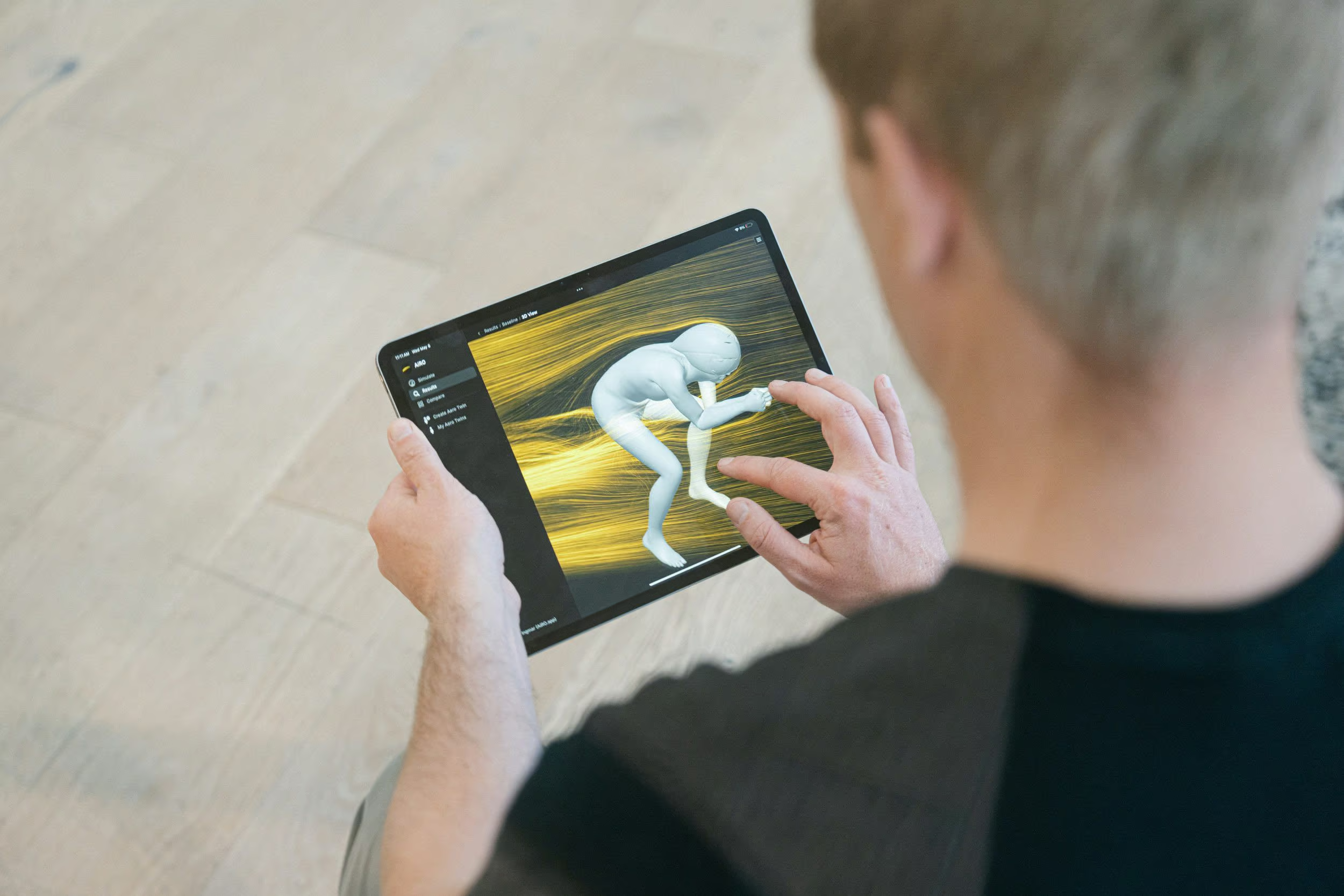
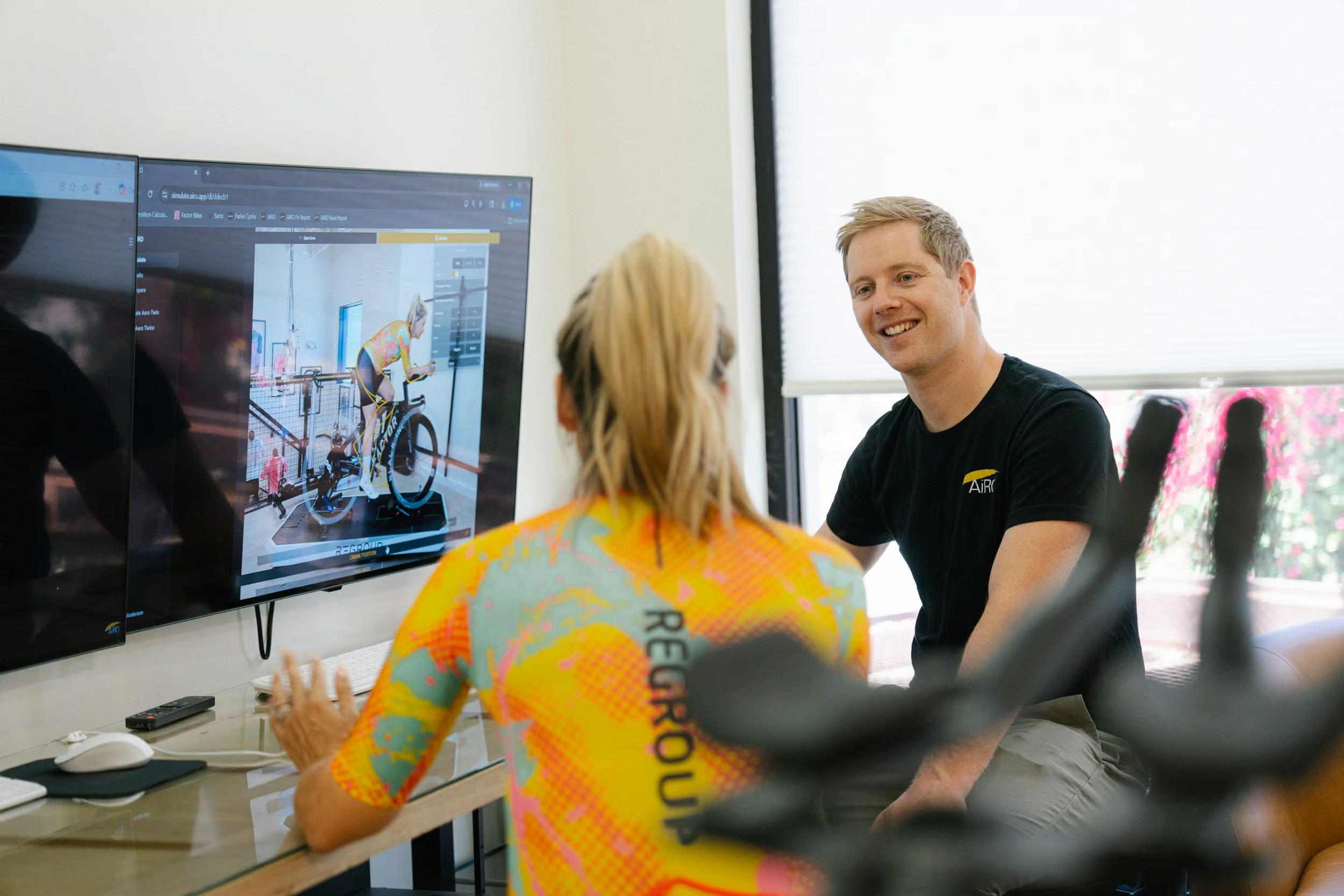
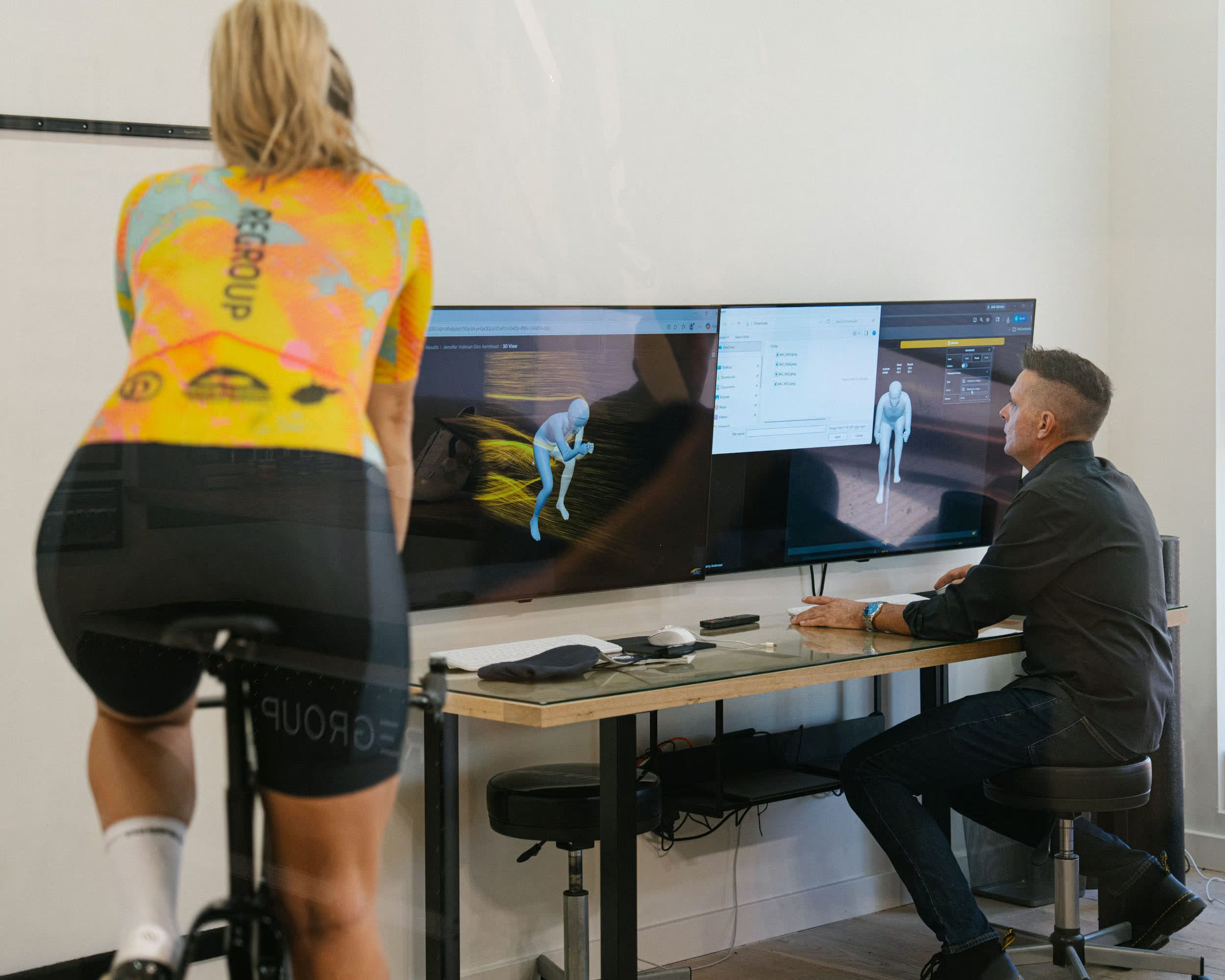
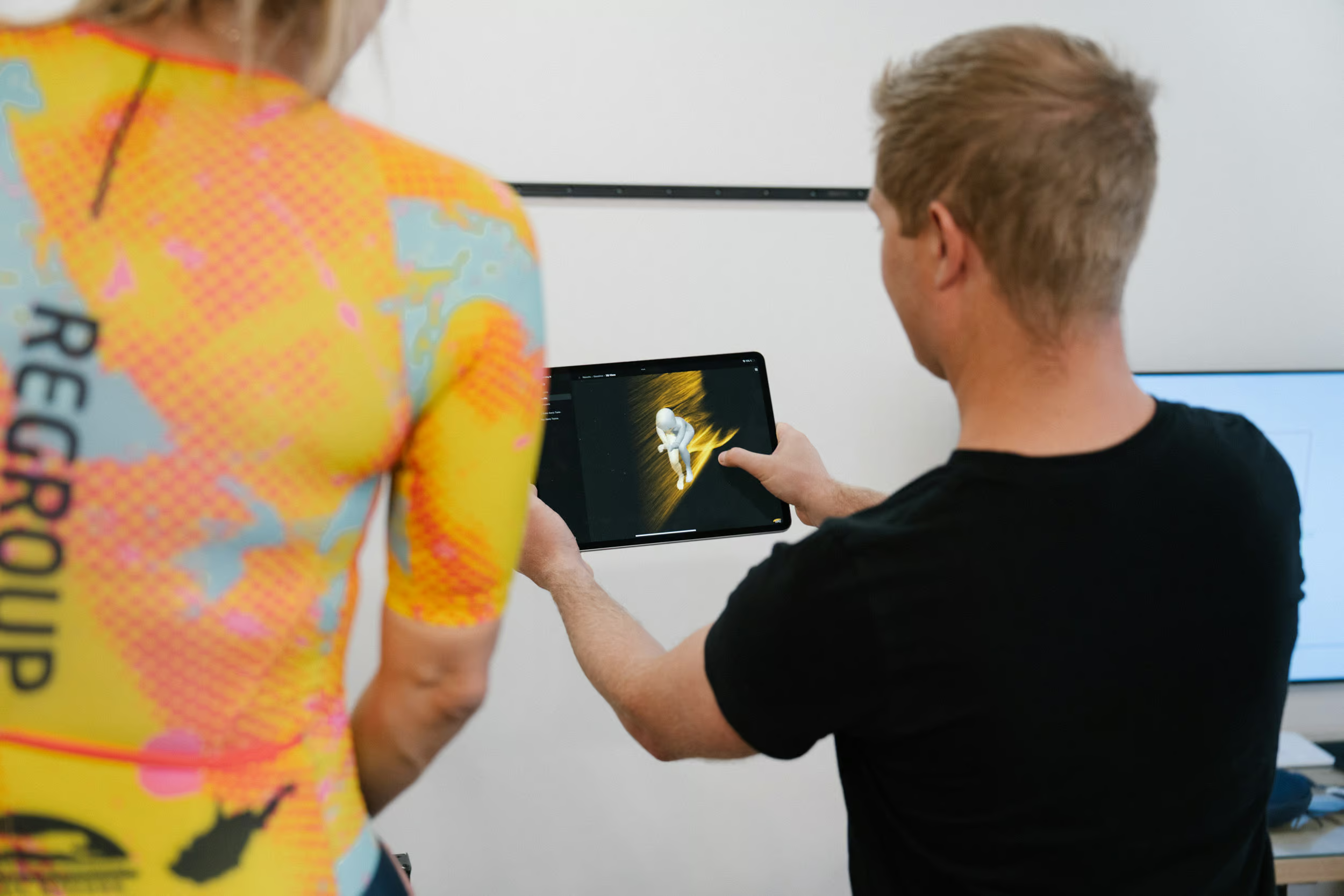
Ingmar, the mind behind the virtual wind tunnel AiRO, came to see us, so we slipped him a coffee, set up a camera and sat him down to ask a few questions.
When Ingmar Jungnickel, the mind behind the virtual wind tunnel AiRO, came to see us, we slipped him a coffee and sat him down to ask a few questions. He'd come by Regroup to shoot training videos for the new software, and we weren't about to let him leave without putting a few things to him on camera.
Barry had a rule going in: none of the questions Ingmar’s already answered a hundred times. Not the company origin story, not the Olympic medals, not the roster of athletes he’s worked with. The brief was the stuff that doesn’t usually make it into an interview — the one product worth buying, the UCI rule he’d bin, what’s actually coming for the road bikes we’ll all be riding in a few years.
If you’re looking for massive rather than marginal gains, this is the one to read. And after that, we’d love to see you in the studio for a Regroup AiRO FIT, and the unlock of all those watts
.
The following has been lightly edited for clarity and length. Barry Anderson, Director of Fit and Biomechanics at Regroup FIT, in conversation with Ingmar Jungnickel of AiRO.
I'm privileged to have the one and only Ingmar from AiRO with me. If you don't know who Ingmar is, well, that's what Google's for. He's been everywhere lately getting interviewed, so today I don't want to ask any of the normal questions. You've been asked about the athletes, about the start of your company, about the Olympics and the medals and the wins. I want to ask some things you might not have been asked before. First one: what's the single thing even amateur athletes should do to improve their aerodynamics? What's the top of the list?
Well, we’re at a bike fitter today, so maybe this isn’t a surprising answer — but fit and posture is by far the biggest change you can make. Sixty to eighty percent of an athlete’s drag is their posture. Only the remainder is the bike. Think about how much a high-end TT or road bike costs now: ten, fifteen thousand dollars and up. To invest a few hundred dollars by comparison on posture, the drag changes you can get run into the tens of watts. It’s a multiple of what you’d get out of an aero bike. So over an Ironman distance, you’re talking half an hour or more of time, and the biggest single lever is aerodynamic posture.
Half an hour. That's the difference between going to Kona and not going to Kona. That's awesome. Next one: what's the one thing every bike shop should carry? The one product we get the most bang for our buck out of — aero socks, aero helmets, what is it?
I’ll give you a different answer depending on where the athlete is in their journey. Table stakes, the basics: if you’re not comfortable on your saddle, if you hate riding your bike, you’re not going to ride it — and you’re certainly not going to hold an aero position. So a variety of good saddles an athlete can actually try, and making sure they find the right one, that’s the biggest and the first thing. The next thing isn’t aerodynamics at all, it’s tires. The difference between a good and a bad tire is massive in every regard. Everybody should just be on the most high-end tires they can. A high-end frame can be thousands more, and the difference isn’t as big as the gap between a mid-level tire and a high-end one. For twenty, thirty, fifty dollars more, the performance an athlete gets from tires — every athlete, whether they’re starting out or not — if you can afford a bike, you can afford nice tires.
Just get the nicest tires you can. Speaking of tires: wide tires and wide wheels, or skinny tires and skinny wheels?
At this point we’re firmly in the wide camp. From handling, from comfort, from a bottom-out perspective — unless you ride only on pristine roads. I’m in Salt Lake City, there’s snow melt, there’s rough stuff besides. For most people, wider tires in the right combination are just an all-around better system. Unless you’re an individual pursuiter riding on a wooden track, in the real world the wider wheels and tires are going to be faster.
Awesome. Silly question — Boas or laces?
I ride Boas, largely for comfort and ease of use. I’ve got a little kid, we’ve got our second on the way, and being able to get on the bike comfortably — I’m a huge fan of Boas. Laces are a touch faster, so if you’re in the setup that wants to win a TT championship, then yes, absolutely. Maybe get both: Boas for training, laces for your high-end racing day.
I'm a Boa person too. Do shoe covers cancel out the Boa penalty? Does a cover wipe it away, or is a shoe cover over a laced shoe still going to be faster?
So shoe covers we should split into two parts. One is the part covering the shoe, the other is the part covering the lower leg. You can do a lot with texture on the lower leg, like aero socks. Whether you’ve got a shoe cover or an aero sock there doesn’t make much difference — ninety percent of the gain comes from the texture on the lower leg, not from what you do to the shoe itself. The covers smooth things out a little, but shoes are pretty clean at this point, so that piece isn’t as important.
Stubbly legs or perfectly smooth legs?
Smooth with aero socks is a really good option. You’re touching on one of the interesting pieces in aerodynamics — we’re right in the speed range we call the transitional range, where you can do a lot with texture. If you’ve seen the high-end textured skin suits, there’s a lot of work being done there. The reason aero socks work is that texture, done right, is a big advantage — again, we’re talking tens of watts. Skin suits are a major performance opportunity, but figuring out which skin suit is right for you is genuinely difficult. Same principle though: if you can get the texture on your leg just right, you’d be even better off.
A bigger, more important question — aerodynamically, what should bike fitters who use your software keep in mind when they're dealing with male athletes versus female athletes? Proportions, body shape — what do we need to be thinking about to optimize a female athlete versus a male athlete?
First I’ll preface this by saying proportion changes within a gender are actually bigger than the differences between genders. So I’ll give some gender-specific recommendations, but the nice part of digital twin technology is you get a 3D model of your specific athlete and can look at that, rather than resorting to broad gender recommendations. The big piece is how your shoulder width compares to your hip width. Some athletes have broad shoulders and narrow hips, some narrow and narrow — you get every combination, across genders. Generally, if you have wider hips you can tolerate a wider hand stance, while on the narrow side it becomes even more important to be narrow.
The other interesting thing — Josh Poertner just talked about this on a podcast recently — is body shape, and breast aerodynamics. The presence of breasts actually positively affects drag. I get a lot of questions from female athletes about sports bras, and that’s really more about the back: if the sports bra has some thickness, it creates a ridge line across the back where the edge of the cutout sits, and that’s what hurts you. But generally, athletes with breasts tend to do a little better aerodynamically than without.
Excellent. I guess I need to get back to the gym and do some more bench presses! A couple of industry questions. Bike design isn't always driven by science — a lot of it's market research, a lot of it's what's popular, you know, crazy-wide handlebars on gravel bikes and so on. But if pure science were designing the next generation of race bike, what would change from what we're seeing today?
We can look at TT bikes and some of the developments there, and I expect those to carry over to the road side. The TT bike ten years ago had no spacers over the stack — everybody had their arms low. Look at a World Tour race cockpit now and the parts have come up ten or fifteen centimeters. That’s not an exaggeration. It’s because shrugging the shoulders and bending the forearms is such a big aerodynamic improvement — twenty-five percent of your drag is the arms.
So the crazy thing is, lots of people who get an aero fit on a road or gravel bike want to go lower, or they show up with the cockpit already slammed. For pretty much every road cyclist racing, their cockpit is faster higher. My somewhat theoretical view, but one I absolutely believe, is that all the bike stack numbers are five to ten centimeters too low, and we’re going to see that change going forward. There’s a company out of the Netherlands leading the charge, a few others heading that way. We see it in track racing. I believe purely performance-based cockpits are going to come substantially higher than they currently are.
"Table stakes, the basics: if you're not comfortable on your saddle, if you hate riding your bike, you're not going to ride it — and you're certainly not going to hold an aero position. So a variety of good saddles an athlete can actually try, and making sure they find the right one, that's the biggest and the first thing. The next thing isn't aerodynamics at all, it's tires."
INGMAR, AiRO
Is that going to come through a taller head tube? Which is faster? A shorter head tube with a stack of spacers and a positive-angle stem? Or a taller head tube? Does it matter?
Not too much. And here’s where it connects with another great trend on gravel right now: if you put bigger wheels underneath it — the research shows larger diameters do substantially better on rolling resistance too — you get those additional inches automatically. These two trends are kind of unrelated, but they work really well together. The conversation tends to go, okay, we want a bigger wheel size, but how do we keep our head tubes short to accommodate it? And I’m saying no — we don’t actually want the head tube shorter. Keep the head tube length where it is, take the bigger wheel diameter, and you get a double win: the higher hand position and the bigger wheel. So the larger wheel diameter on gravel might fit really well with the revolution we’re about to see in cockpit heights.
Last one's personal for me. I spend a lot of time bumping up against the edge of the UCI rules — I know I can often make someone faster and more efficient if I take them outside the UCI box. In general, is there one UCI rule you'd like to get rid of?
That’s a great question, and it gets debated a lot in the race-engineering world I’m in. Within the existing rules, I actually don’t have a strong view — we try to find the biggest advantage we can within them. But at a higher level, it all goes back to the Lugano Charter, where the UCI got together and set the direction, explicitly saying they don’t want technological progress to dominate the sport. I think that created a culture where engineering bike companies are in direct conflict with the UCI.
Many customers want bikes that go faster — that’s what they’re excited about, it’s what keeps the industry healthy. Going faster is a key part of the progress of the sport. Go back to the Olympic motto — higher, faster, stronger — that’s explicit. To codify, as a federation, that we don’t want faster to be part of our sport creates a lot of conflict. Now, I understand crash risk is directly tied to kinetic energy, to how fast an athlete is going, so I see that side of it. But I think it’s critical for us as a sport to say going faster is part of our mission. Cycling without technology already exists — it’s called running.
From the very invention of the bicycle, the idea of adding mechanical construction underneath you, gears, pedals, all of it, was about how fast can we go on human power. So I think that the marriage of human power, human performance and technology is what cycling is, and it’s what attracts a lot of people to it. So I’d question the Lugano Charter at a high level and say, maybe the federations, maybe the UCI, can revisit that stance and ask: does technology really have no place in cycling, or is it an integral part of it?
Higher, faster, stronger. Thank you for what you and AiRO are doing to get us all faster, stronger and higher.
Thank you for working with us — it’s been an amazing journey together. Let’s see where we can get our athletes over the next years and decades.