TECH

AIRO at Regroup FIT

With the arrival of Airo and its advanced digital wind tunnel technology at Regroup Fit, Barry Anderson reflects on tinkering, bike fitting and the benefits of backwards thinking.

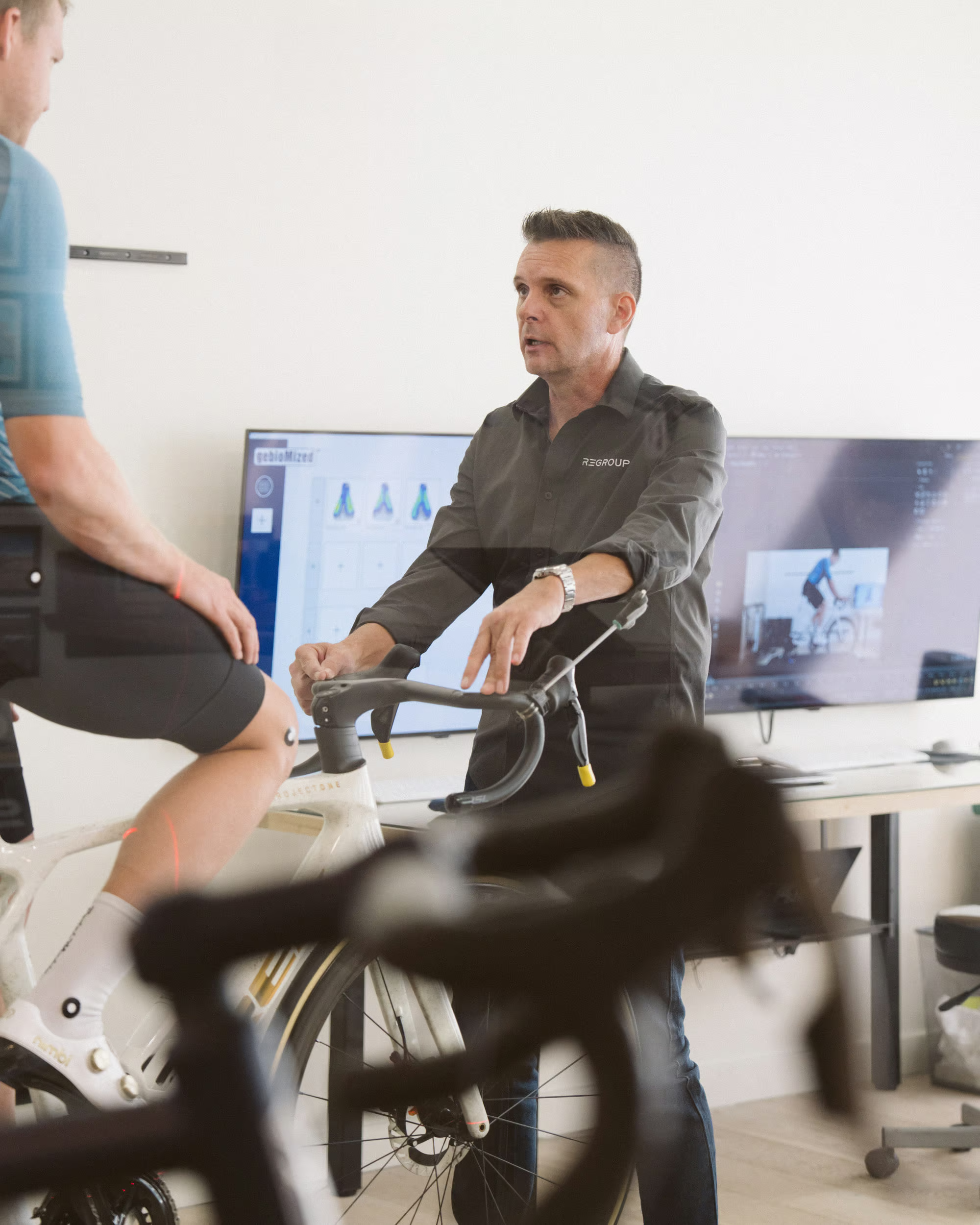
Airo at Regroup FIT bike fitting.

WORDS

Barry Anderson

PHOTOS

Daniel Koeth

When I was a little boy, I was notorious for taking things apart and putting them back together. Toys. The back of the TV. A clock. A speaker. My dad’s stereo. Needless to say, my dad wasn’t a fan of my endeavors. I kept at it, though. Figuring out how things work was not something I was going to give up, so if I was going to keep taking things apart? I also needed a way to put them back together… and, most importantly, quickly. I developed a system where I would make grids on a piece of paper. The first screw I removed would get placed in the first square. The second one is in the second square. I’d work my way through the process, and about an hour before my dad got home? I’d work my way backwards through the grid and arrive at the beginning.

Over the years, I unconsciously started to approach everything in life that way. If I need to be at a meeting at 9am, how long does it take to get there? Thirty minutes? OK, so if I need to leave the house at 8:30am, what time do I need to finish my ride and get in the shower? 8am? OK. If I need to be back at 8am and I’m going to ride 40 miles, when should I leave the house? 6am? OK. If I need to leave at 6am, what time do I need to set my alarm so I can eat and put air in my tires, fill bottles, and get dressed? 5am? OK. The alarm gets set at 5am. So, to know where to begin, I always start at the end and work my way backwards. The mental gymnastics might sound crazy to you, but in my brain, it is a 5-second process that I do all the time.


And it has always seemed completely natural. Until recently, I had absolutely no idea that not everyone thinks this way. It never even occurred to me that there was another way to get through life until Dan Bigham wrote his book, “Start at the End: How Reverse-Engineering Can Lead to Success.” I heard someone describing the book, and my first thought was… Well obviously. How else would you do that?


The person I was speaking with looked at me like I was completely insane. I didn’t get it and looked back at them, completely baffled. What do you mean? You don’t think backwards through problems? Nope. Apparently, Dan and I are not typical “end users” (pun intended).


Now that I know my personal process is just that, my personal process, I have started to notice other backwards thinkers, and I am usually very intrigued by whatever they happen to be working on. They are easy to identify. Reverse problem solvers stick out in their industries. They are usually viewed as disruptors and instigators. People around them view the same thing from completely different angles. I don’t think that one way is better than the other, but they are definitely different.


Recently, I was listening to the Marginal Gains podcast (highly recommended), and a brilliant, backwards-thinking thinker practically leapt out of the speakers.


Ingmar Jungnickel and his company AiRO are disrupting the high-performance world in the best way possible. The technology  is undeniable, but it is the process that has gotten me so excited.


Imagine you are a world-class time trialist, and you want to win a gold medal at the 2028 Olympic Games. You would meet with your coach and set a training plan. You would meet with your trainer to make sure you were doing the right off-the-bike routine. You would meet with your equipment suppliers and ensure they could provide the fastest setup possible. You would meet with your bike fitter to ensure the bike is set up correctly. You would meet with your nutritionist to make sure your diet was appropriate for the workload.


And then you would start training. The workouts would steadily get harder and harder. You’d make improvements in equipment as they became available. You’d periodically tweak your position to accommodate changes in your physiology. All of that work would hopefully make you a little better every day, and 18 months from now, you would be in the best possible shape and riding the best possible equipment, and you’d pedal as hard as you could and try to win.


Traditionally, that is how these things are done. In this case? Tradition isn’t good enough. In today’s modern peloton, doing things the way they have been done for the last 50 years will leave you in the middle of the pack. You want to compete today? You have to start at the finish and work your way back, and that is what Airo has done with their amazing new CFD software.

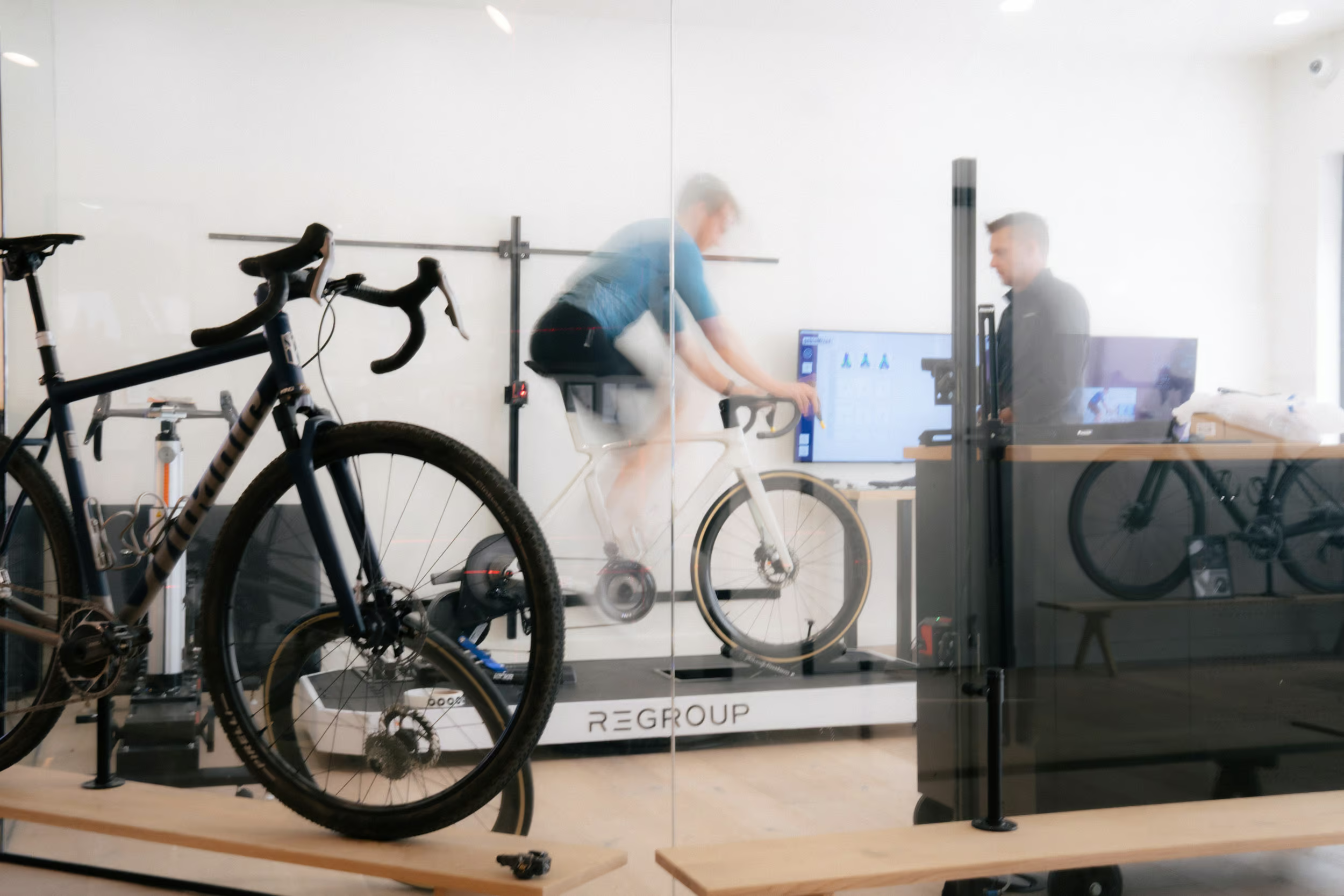
Barry working backwards at Regroup Fit

Planning for a gold medal in the TT now involves first establishing how much power at a given CdA is needed to complete a given course with given wind conditions in a given amount of time. If, as a hypothetical example, we know from analyzing past races that in order to win, the rider needs to be able to hold 400 watts for 40 minutes with a CdA of .23, we would take those measurements and use them as our starting point. The end becomes the beginning.


The AiRO software allows me to create a 3D avatar that is shaped exactly like the rider, and then manipulate it digitally into what will theoretically be the fastest possible position. When I say “theoretically?” That is exactly what I mean. This is an exercise in “what if?


Modern TT positions are almost impossibly physically demanding. That being said, the most aero position is always the one the rider can hold for the entire race. If they can only hold it for 30 of the 40 minutes, then the figurative wheels are going to come off, and the rider will fade dramatically.


Let’s say that using the AiRO software I find that I can contort the rider into a position that has a CdA of .19. That means that the rider will be faster if they can hold the 400 watts in that position, OR that the rider will be able to go the same speed as when their CdA was at .23 only now fewer watts are required.


Keep in mind that the .19 position is not currently possible. The rider can’t hold it, and if we tried it in the studio, it would have been rejected.

But with AiRO software, we are no longer limited by what is, because we now know what is possible.


This is when the thinking backwards gets fun.


The next step is to get everyone from the high-performance team in the room at the same time. The athlete, coach, trainer, bike fitter, nutritionist, and equipment suppliers all get together, and we evaluate our theoretically possible race strategy (400 watts for 40 minutes with a CdA of .19). We place the rider into the position and see what physiological barriers there are to accomplishing it in the real world. We can identify things like:


  • We need 15% more hamstring flexibility.
  • We need 20% more thoracic spine mobility.
  • We need a 10% increase in VLaMax.
  • We need a helmet with 10% less surface area.
  • We need to be able to have a 2-degree lower core temperature at the start.
  • We need, we need, we need…

We then take each of the things holding us back from our end goal of 400 watts for 40 minutes with a CdA of .19 and break down the steps to get there. We create a calendar and mark the race date on it. We work backwards through travel and acclimatization and recovery, and training cycles until we get to today, and suddenly the entire high-performance team knows exactly what they need to accomplish, and when it needs to be accomplished by.


This technology and methodology can be applied not only to TT and tri bikes, but also to road, gravel, track, and mountain bikes. We can assess your performance goal and break down the steps needed to get there.


…and we do that by starting at the end and working our way back!