GEAR DIVE

Should you Short Crank?

Regroup FIT's Barry Anderson dives into the details to see if going short might suit your ride.

Regroup FIT's Barry Anderson dives into the details to see if going short might suit your ride.?

WORDS

Barry Anderson

PHOTOS

Peter Harrington

So you want to know about shorter cranks. You’ve read about how the pros are all doing it. You’ve seen that the manufacturers are embracing it. Your buddies are talking about it. Now you want to know whether or not you should try as well. Before you start throwing money at your bike, let’s first talk about why you might want to head down the short crank road, and (just as importantly) why you might not want to.

There are as many reasons to shorten the crank on a bike as there are cyclists riding, but just because everyone is doing it, doesn’t mean that you should too. For our purposes here today, we will focus on the two primary reasons why you and your fitter might consider a different crank length. Keep in mind that crank length, like any equipment choice, is an individual thing. Just because your riding buddy moved from 175 to 165 cranks and got faster, does not mean that if you make the same change you will see the same results. Before investing in any new equipment, I highly recommend that you consult a qualified, experienced bike fitter who not only understands biomechanics in general, but who also understands your specific biomechanics, riding style, and needs.   So without any further delay, let’s dive into the first reason many riders move to shorter cranks.

REASON 1: HIGH PERFORMANCE

There are specific instances at the pointy end of the competitive stick where the proper use of a shorter crank can generate a competitive advantage.


Imagine for a moment that you are a professional crit racer. You have a big engine, and can stay at or above threshold for an hour, but… If the race comes down to a sprint you simply don’t have the explosiveness to compete with the pure sprinters. The only way you can win? Off the front. So what do we do? In addition to checking every single aerodynamic box we can find, we are also going to be taking a long hard look at the crank length on your bike. What would happen if we dropped you to a very short crank length and installed a huge chainring? Well, that shorter crank would allow you to pedal through every single corner at full speed, without worrying about pedal strikes. While your competitors coast through the corner and then sprint out of the apex, you are putting a bike length on them through steady application of power.


Time trialists and breakaway artists may also benefit from a shorter crank. One of the limits to how low or long we can make the front of a bike is how close your thigh is to your chest at the top of the pedal stroke. As we lower the torso, we are essentially folding the rider in half. At a certain point, the rider runs out of room and is forced to make space by either rotating their pelvis posterior, moving their knees out laterally, or rocking their pelvis out of the way. All of those compensations have the potential to completely blow your aerodynamics, comfort, and efficiency. If your job is to spend all day suffering with your nose in the wind pulling the peloton, pushing the break, or racing time trials or triathlons, then a shorter crank will give you more room at the top of the pedal stroke, and may make that job much easier.


Lastly, let’s talk about Tadej Pogacar. Why? Because he just might be the greatest cyclist of all time, and his adoption of shorter cranks is what has really put them in the spotlight. Bike fitters like myself have been talking about shorter cranks for well over a decade, and science has been investigating it for even longer. I’ve been a well known, high volume bike fitter for a very long time, and I can remember more instances than I can count where people in the industry told me I had it all wrong.


But when someone spotted 165 cranks on Pogacar’s bike that all stopped. So why does Pogacar ride shorter cranks? Well, let me preface this by saying that I have no inside information, nor any connection to him, to his team, or to their biomechanist. What I do have is about 40 hours invested into analyzing his position over the last two years. I’ve taken countless screengrabs, ported race video into Dartfish to slow it down, and studied his push vector until I’m nearly cross-eyed. What did I find? I found that when he scoots forward onto the nose of his saddle for that devastating seated attack of his, his knee extension is consistently between 130 and 135 degrees. To put that in perspective, the average amateur athlete with average flexibility is usually happiest around 143 to 145 degrees. In other words, Pogacar’s saddle height when he attacks is crazy, crazy low. I won’t bore you with why a “low” saddle height has the potential to allow a rider to produce more power (that’s another article for another day), but in certain cases it absolutely can. The problem with that super low saddle height though? On a 172.5 crank, his knee would be 15mm higher at the top of the pedal stroke, and he would almost certainly be encountering hip restriction and lowering his respiratory efficiency… Which brings us to the second part of our short crank explanation.

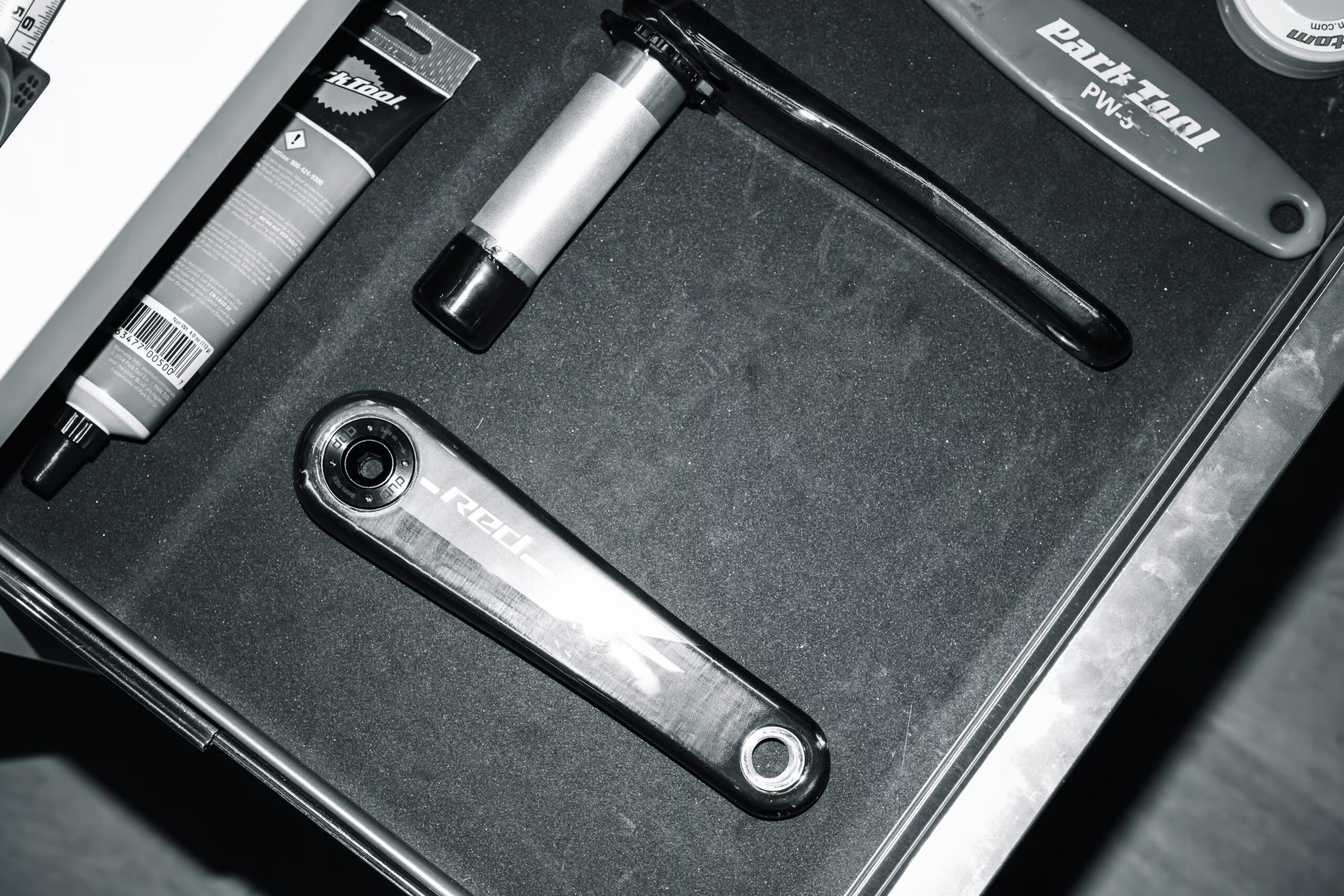
We dive into the details os short cranks to see if trimming some length might suit your ride.

Reason 2: Accommodating Biomechanical Limitations

It is all well and good to talk about what the pros are doing, but it is quite another to try and imitate them. If most of us tried to ride with a knee extension under 135 degrees, our knees would explode from the load, and riding a bike would be miserable. The shorter crank though? That might be worth looking into.


The primary reason most athletes might benefit from a shorter crank has to do with the load that their hips and knees are absorbing at the top of the pedal stroke. Cycling is what is called a closed chain activity which basically means that you can’t get out of your own way. If the crank is pushing up at the top of the pedal stroke and bending your knee more than it wants to bend, or pushing that knee closer to your chest than your hip wants to absorb, the crank does not care. It is going to keep pushing into that restriction until something gives, or you figure out a way to give yourself more room. The most common ways that cyclists make room for their hips and knees on the bike is to:

  • Move away from the joint that is having a problem. If you are riding behind someone and you notice that they aren’t sitting in the middle of the saddle, one possible cause is that the crank is pushing into joint restriction, and the rider has to physically move away from it.
  • Move their knees out laterally. We have all seen riders cruising along with their knees pointing east-west while they are pedaling north or south. It looks uncomfortable and awkward, and more importantly, it is definitely slowing the rider down. That being said, those knees pointing out is a protection mechanism that is helping to keep their hips healthy (at the expense of their knees). If the rider were to mentally bring their knees in, they would see their power numbers go up, but they would have inadvertently turned off the thing that was protecting their hips.
  • Rock on the saddle. Sometimes people rock on the saddle because their saddle height is too high, and they have to rotate left and right off the saddle in order to reach the bottom of the pedal stroke. Other times it is because the crank is pushing their knee up past the point that their hip can absorb, and they are physically being shoved across the saddle.

All of these adaptations enable riders to keep pedaling without impinging their hips. But because the rider is trapped on the bike the load that the hip was going to absorb just gets shifted somewhere else (knee, lower back, saddle sores, etc). In many instances, if the rider and their fitter shorten the crank, they are able to bypass the restrictions, and the rider no longer has to unconsciously protect themselves by shifting off the center of the saddle, deviating their knee tracking, or rocking on the saddle.

Other Considerations

Buying a new crank is not an insignificant purchase, especially if you have a power meter. Our sport is an expensive one, and we all have to decide how and when we invest. I almost always recommend that a rider first consult with a qualified physical therapist to see if the hip mobility issue is fixable. Afterall, if your hip and knee can absorb it, there is theoretically no wrong crank length! Sometimes investing $200 with a PT will yield better results than spending $1300 on a new power meter crank.  You get to decide whether you invest in yourself, your equipment, or both.


One of the byproducts of a shorter crank is that the rider’s cadence almost always goes up. They no longer have to use energy to fight their hip or knee, so they can use that energy to move the pedal instead. I’ve seen that extra energy, combined with the smaller circle, to instantly increase a rider’s cadence by 10, 15, and even 20rpm. Sounds amazing, right? Well, sometimes it isn’t. You will be the most efficient at the cadence you practice, and if you have spent the last 20 years practising a 70 cadence, then have a guess what you are very, very good at. That’s right, you are an expert at pedaling at 70. Your neuromuscular firing patterns are wired to that, and your muscles are highly attuned to contracting at that rate. If we free things up and all of a sudden you find yourself pedaling at 90, I can guarantee that you will feel gassed much sooner during a ride than when you were pedaling at 70. Why? Because you are metabolically efficient at pedaling much slower. At this point, you will need to decide whether to accept the fact that you may be inefficient for a while and learn to pedal faster or get a bigger chainring to slow that cadence down a little bit. Or do you do a combination of both? I almost always recommend that riders meet somewhere in the middle.


So are shorter cranks for you? Maybe. If you have less than ideal mobility? Probably. If you are a bike geek with a big enough equipment budget that lets you tinker? Absolutely! Just remember that everything on a bike affects everything else. When we shorten the crank, the saddle will need to go up and possibly back. If the saddle goes up and back, then the bar and stem may need to be adjusted. If it all sounds like a bit much to tackle you on your own, give us a call (480-648-8309), or stop by the shop and check out the Regroup FIT process for yourself. We’d like nothing more than help you get more comfortable, efficient, and yes, faster on your bike.