Factor CEO Rob Gitelis on the Brand's Unique Approach
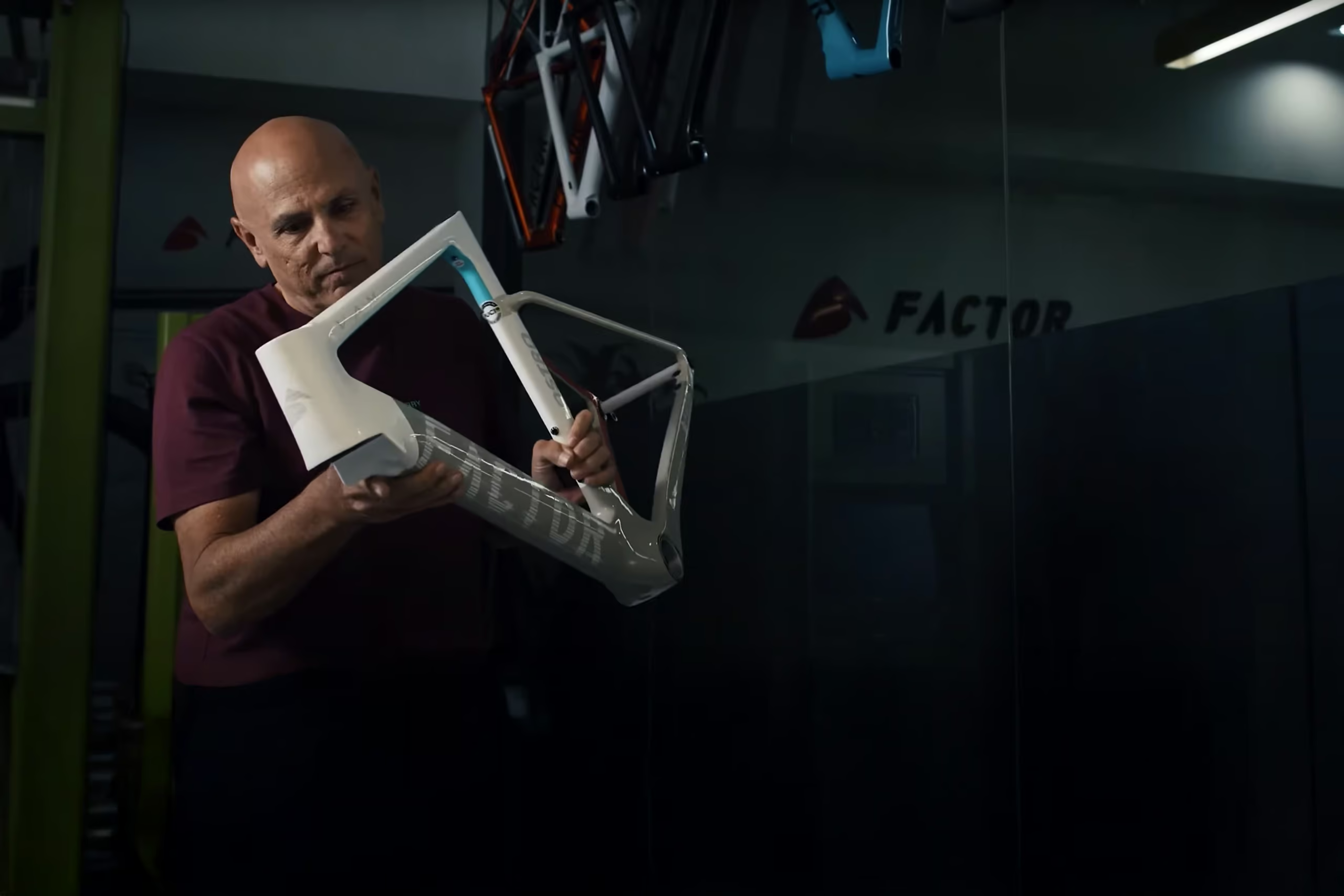
We caught up with the CEO of Factor Bikes, Rob Gitelis, to find out about the brand's singular pursuit of performance, and why every ride should be an experience.
January 11, 2025
visibilityPEOPLE
The Factor ONE ushers in a new era of whole-stage aero. Before the launch, we heard from Chief Engineer Graham Shrive, who explained how the bike came to be and why it's a lot less controversial than the press would have you believe.
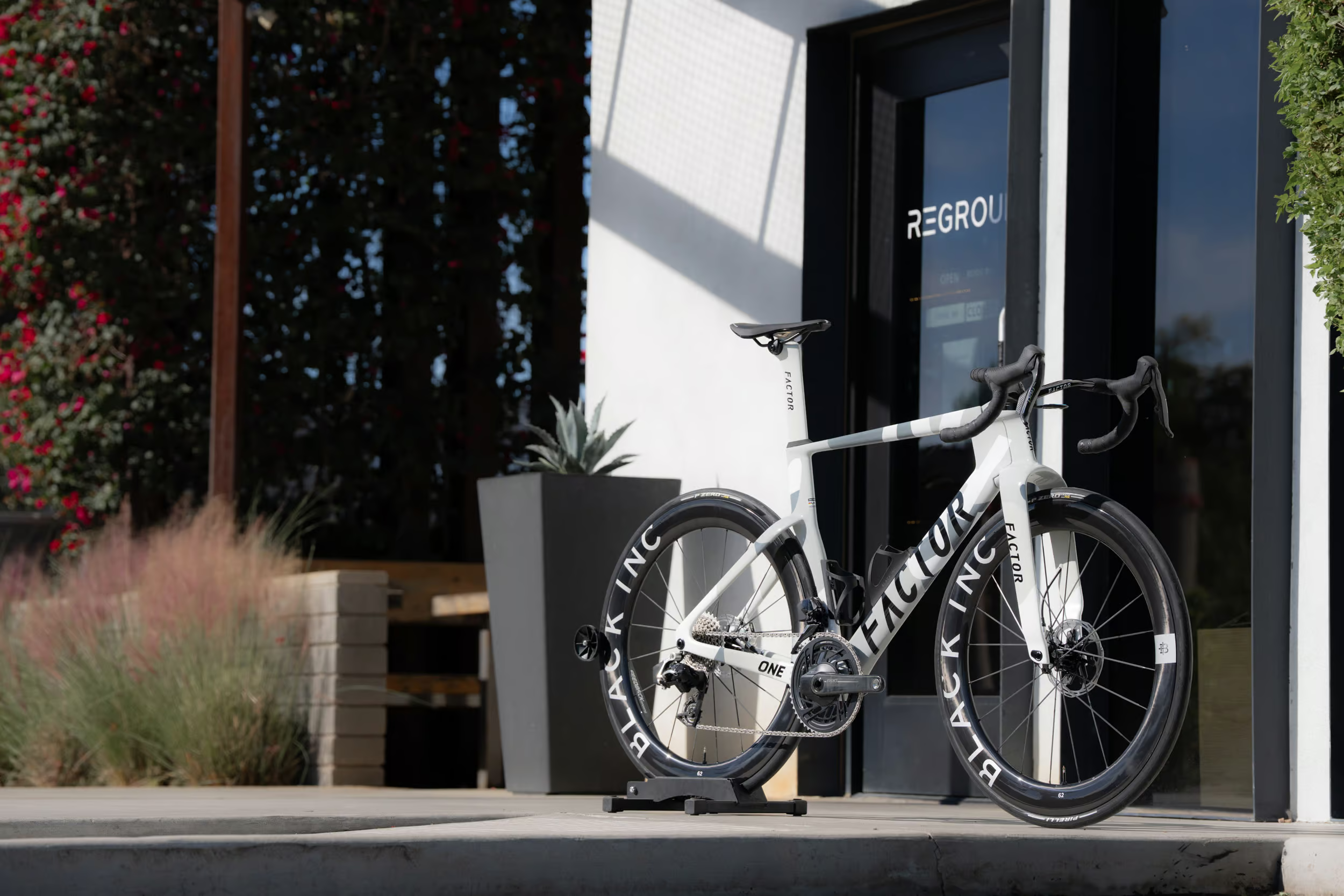
Search for the Factor ONE online, and you’ll see a model from almost ten years ago, a variation, as Rob Gitelis, Factor’s CEO, explains in the release film for the new ‘ONE’ bike, of the brand’s VisVerez. Although illegal in the UCI's eyes, the brand’s original ONE was, he says, “a very special bike.” Fast and futuristic, it gave rise to the tantalizing idea that before long, a time might come when aero above all would define Grand Tour road cycling. With today’s release of the new Factor One, that time is now.
“We kind of viewed it as more of a breakaway bike,” says Factor’s Chief Engineer, Graham Shrive of the new Factor ONE in the same launch film. He cites Steve Cummings’s win on stage 14 of the 2015 Tour de France as an example of a very carefully calculated form of racing, “where it was dictated how he was going to win, and the wattage he would need at different parts of the stage.” But, according to Graham, it was a request from Alex Dowsett to have a lead-out bike that would allow him to stay on the front for an extra 100 metres, 200 metres, 300 metres, that gave rise to the initial development of the Factor ONE; a bike that would allow him to stay on the front of the sprint for longer “when he’s stringing the whole peloton out and protecting the position of his sprinter.”
As Graham notes, it was an unusual request because Factor’s design team hadn’t really ever considered that application; rather, they were toying with a concept of a very calculated aero bike optimized for the whole stage. But while sprinters always need an edge, the racing style and methodology that snagged Steve the victory back in 2015 gained traction, proving to Graham and his colleagues that the ONE concept had legs. Although perhaps we should say, wheels. “We’re seeing that style of racing absolutely dominate the World Tour,” says Graham. “The sports scientists are completely modeling stages in terms of elevation and wind. There’s live data coming in from different wind stations. You’ve got soigneurs and bottle handlers out on the course with wind meters, and amateurs trying to detect the direction and magnitude of the wind, then advising the teams based on that. And because of these developments and the peloton’s ever-increasing speed, the willingness to accept a bike like the Factor ONE has increased.“
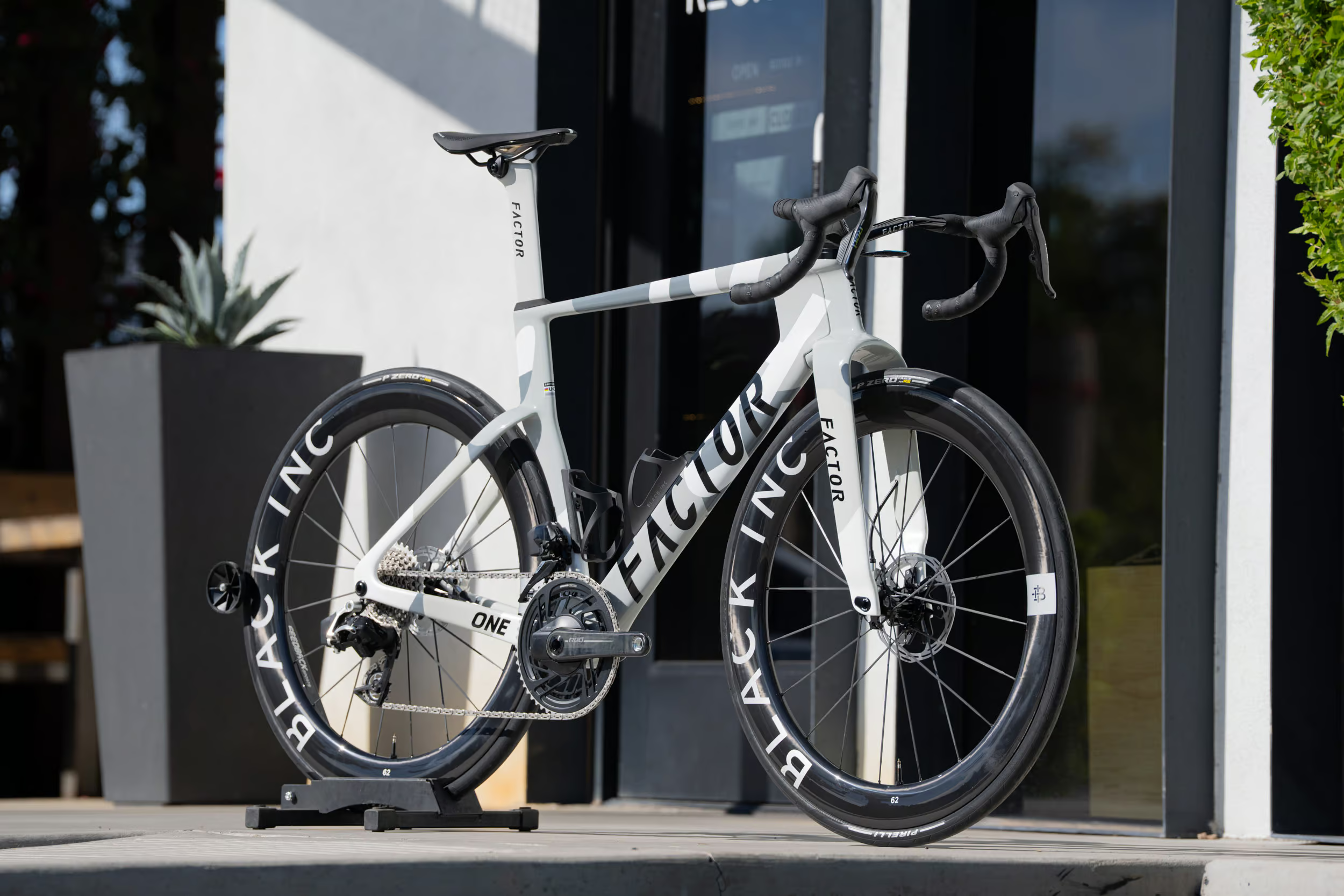
To say the Factor ONE is a bold design is like saying the Tour de France is a little bit tough. For a whole-stage bike, the Factor ONE is a radical design, far removed – although the gap is closing each season – from a cyclist’s expectations of what a road bike should look like. “The geometry of this bike is extremely bold,” agrees Graham. “And that’s inherently a commercial risk. A lot of bike companies will try to remove every element of risk and go for the lowest common denominator – bikes defined by supply chain directors. That leads to compromised decision-making. At Factor, Rob and the design and engineering teams drive those decisions, which is the way it should be.”
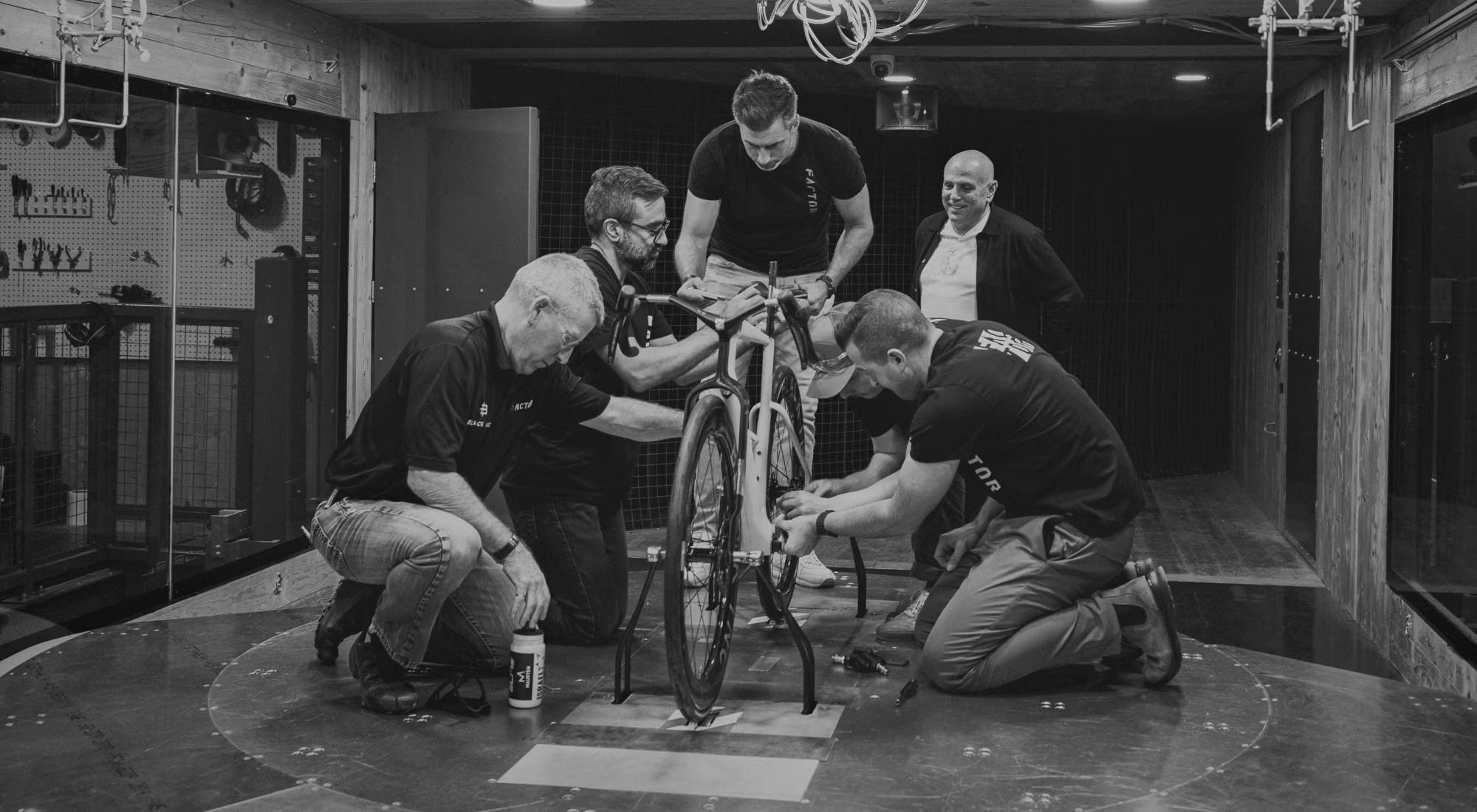
The aerodynamics of the Factor ONE might grab the headlines, but Graham is keen to stress that what you see is not a lightbulb moment made real – the work of an instant realized as a new design – but a project that reflects “the cumulative experience of our team, both in terms of design, CFD work, as well as implementation at the factory floor. Everything builds upon everything else, and what we’ve seen with this bike is that projects like the Australia Track bike with the Hanzo really improved our understanding of airflow. The availability of more advanced CFD tools and computational tools has really, really increased how we can visualize what that airflow is doing and helps us understand how we can make meaningful changes with the bike design.”
Those are the internal elements that Factor can control, but Graham also emphasizes the importance of changes in the wider world, such as revised UCI rules and a relaxation of minor details in those rules. And how fast everything has gotten. “You know, an entire stage is run at 50 plus K an hour, teams sitting on the front for hundreds and hundreds of kilometres, World Championships being won in 100+ kilometre breakaways. I mean, this is a different sport than what it was five or six years ago.”
Graham Shrive
Aero brings many benefits, but aggressive shapes risk leaving pro and amateur alike feeling the strain of the miles. Recognizing that reality, Graham says that Factor ONE “meets those riders where they’re at,” instead of forcing them into uncomfortable positions that would end up cutting speed anyway. Comfortable is fast, after all. “Any brand can provide a negative 10 or negative 15mm seat post in terms of offset from the bottom bracket,” he says. “But there’s a knock-on effect from those position changes as riders try for ever more aero, and that’s things like 150mm stems, and severely compromised front to rear weight balance, high center of gravities as the rider comes up to accommodate, say, shorter cranks and a more upright position.” Factor’s ethos, says Graham, is to “support fitters in where they’re trying to take the rider’s bodies, and make sure that the ONE handles in a safe and effective fashion.” With the rider representing about four times the drag of the bike alone, getting the person into an aero position that is comfortable from start to finish, often over repeat days, is, according to Graham, where the Factor ONE shines.
So what has Factor done with the ONE that moves the speed needle? “The front end of the Factor ONE is the showpiece and where a lot of the tension is focused,” says Graham. “It’s certainly aerodynamic, and one of the reasons, beyond well-understood concepts, is a decoupling of the mounting area of the actual bar or stem from the center axis of the rotation, which splits up the compression function from the bar attachment function, shortening the moment arm of the rider’s torque to the bike frame itself, thus improving the stiffness. In this case, we’ve been able to increase the stiffness of the bar itself by over 50% relative to the equivalent length of AB02, our typical aero handlebar.”
Still, the Factor ONE’s radical lines have given rise to some confusion, he admits. Although to Graham, it’s pretty simple. “We’ve effectively tried to mimic what we call an effective stem length,” he explains. “There is no stem on this bike, so it makes it kind of difficult to decide how to indicate where the reach to the levers is. What we’ve decided to adopt is a simple number system: 1, 2, 3, 4, 5, and each number corresponds to the equivalent fit or equivalent length stem on an Ostro with that length of stem. So a 1 would be equivalent to a 110, and so on and so forth up to a 150, which is a stem like we’ve never offered on the Ostro. The reason we’re starting at 110 rather than, say, 90 is that the bike’s C-tube angle is significantly steeper, putting the rider’s position much closer to the bar. So it would be quite straightforward to replicate the fit of a rider on, say, a regular Ostro with a 90mm stem using the number one stem and a zero offset seat post.”
Some riders, though, may be alarmed that they can’t raise or lower the Factor ONE’s bar. “It was quite a challenging area for us to address,” says Graham. “The reason is that on an aero bike, as soon as you start to add spacers or these kinds of things, it really severely compromises both the aero performance as well as just the general aesthetic look of the bike. One thing we wanted to make sure of was that riders could get into a comfortable position while maintaining the ONE’s racy looks and without significantly affecting the aerodynamics. We made a decision very early on in the project to provide a limited amount of stack increase using spacers and make a secondary bar, which we offer in sizes 1, 2, and 3, that adds 20mm of effective height to the levers. When combined with the 15mm of spacers that ship with every frame, this gives you an effective fit range of plus or minus 35mm to the front end.”
If you have experience with the brand’s Ostro, Graham says that popping a leg over the Factor ONE will put you in familiar territory. “The stack on the bike is almost exactly the same as the current Ostro. The reach is somewhat longer, but that’s offset by the steeper C2 angle. And so what you end up with, again, is a normative range that’s quite within a reasonable amount for most riders. Very similar to the current Ostro.”
Turning to the breadth of Factor ONE’s size range, Graham explains that, when it comes to fit and handling, particularly across smaller sizes, “oftentimes the coordinates are driven by elements other than those that influence the ride quality.” He goes on to explain the importance of front center distance, or the distance from the rider’s toe to the front wheel, which tends to dominate the way that small-sized bikes from 54 and below handle. Noting that, “as the bike shrinks down, as the reach reduces, the wheel naturally comes closer towards the rider’s center of rotation around the bottom bracket.”
What, he says, Factor has been able to do is extend the reach on the bike, removing that front-center challenge from the equation. “That’s allowed us to do two things, depending on the size. On the larger sizes, the 58 and 56, we’ve decided to increase the wheelbase length to compensate for what we view as the rider’s increasingly forward movement on the center of gravity. And the rider is much more likely to have handling issues related to a very high center of gravity when sitting more aggressively over the front wheel on larger sizes than they are on smaller sizes, simply because the rider’s distance to the front wheel is reduced. So on the larger two sizes, we’re trying to diminish the amount of overcoming moment that’s possible from that rider, and that being the tendency to flip over the handlebars.”
That’s the larger sizes of the Factor ONE, but what about the smaller sizes? “On those, we’ve elected to supply the steepest possible head tube angle we can, so that those bikes handle exactly the same as the larger size bikes.” What you’ll see across some sizes, he says, is an increase of up to 2 or 2.5 degrees in head tube angle to keep the front center at the same dimension. The result on the road, he says, translates to “a really, really tremendous ride feeling and sensation. What they’ll feel immediately is that the gravitational effects on the front wheel have been reduced dramatically. And you get a much more snappy feeling handling out of the bike.”
Moving to the overall handling of the Factor ONE, Graham tells us that it’s tremendously sharp, “particularly when climbing.” He credits the ONE’s ‘wild’ front end stiffness, in part, to its four bolt attachment as well as the offset bolt location from the center axis. He makes particular mention of a detail found on small sizes, where the bike’s steeper head tube angle reduces “the so-called flop that you get at low speeds.”
On the bigger sizes, Graham explains that the ONE’s longer wheelbase allows the rider to “sit in the bike instead of on the bike,” noting that a “lower bottom bracket and longer wheelbase tend to give a more confident handling and feeling bike.”
The most interesting thing about Factor ONE might not be the bike, but how the rest of the Grand Tour crowd of brands react to its blistering pace. They might follow, but Graham’s firm belief is that only Factor could have made the ONE. “It was pure performance from the get-go. How can we help riders win races? That was the only driving principle behind this bike. And you know it’s very rare in life or in business to be able to have that clarity of purpose and have that clarity of purpose carried through by all aspects of the business. No one involved in this process ever put a stop to something because it was going to be too hard, it was going to take too long, or the materials would be too exotic. At no point were there any limitations placed on the ONE. We simply wanted to make the world’s fastest road bike and help riders win races. That was all.”

FEATURED
Go beyond speed, peers, measure and possibly reason with the formidable Factor ONE, an unapologetically aero road bike for the rider seeking pure, unadulterated pace.